Garage Floor Tile Questions, Answered
What is the best garage floor tile?
The best garage floor tile is a solid PVC tile — not hollow-core polypropylene — at least 1/4” thick, with a continuous locking system and a verified vehicle load rating. The simplest quality test is weight: a premium tile contains 3.5–5 lbs of solid virgin PVC, while hollow peg-and-loop tiles weigh under 1 lb with just a 1/16” wear surface. When the U.S. Army ran competing interlocking tile systems through procurement testing at Fort Benning, it selected solid PVC T-Joint tiles — the full report is on this page.
Are solid or hollow garage floor tiles better?
Solid tiles are better for any garage that holds vehicles. Hollow-core tiles have only a thin wear surface over empty air, so they dent under jack stands and tool chests, form wear paths under tires, crack at their locking tabs, and make a click-clack noise underfoot. Solid PVC is the same material all the way through — it can’t collapse into a cavity, deadens sound, and is why solid tiles carry lifetime warranties while hollow tiles carry limited ones.
How thick should garage floor tiles be?
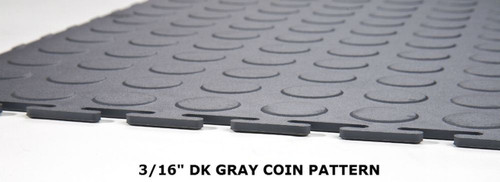
For garages with vehicles, 1/4” of solid material is the standard; 3/16” solid tiles suit standard residential vehicles and light commercial traffic, and 5/16” is the heaviest grade for forklifts and equipment. Be careful comparing numbers: hollow tiles advertise 3/8”–1/2” thickness, but that includes the hollow air space — their actual solid wear surface is typically 1/16”. Measure material, not height.
How much weight can garage floor tiles hold?
It depends entirely on construction. Solid PVC garage tiles are rated up to 160,000 lbs roll-over and 80,000 lbs static load — enough for fully loaded fire engines, forklifts, and hydraulic lifts, and proven at Kyger Creek Power Plant where they carry forklifts moving 100,000-lb turbines. Hollow-core tiles concentrate point loads onto a thin shell over air, which is why heavy jacks and stands dent them.
Are peg-and-loop garage tiles any good?
Peg-and-loop tiles are fine for display areas and light foot traffic, and their low weight keeps them inexpensive to ship. Their weakness is under vehicles: the connection relies on a few small tabs that crack and pop loose under turning wheel loads, and the hollow core beneath the wear surface dents under point loads. A continuous T-joint locking system that runs around every edge of every tile stays locked where tab systems fail — which is exactly what the Army’s side-by-side testing was measuring.
How much does it cost to tile a garage floor?
Our solid PVC garage floor tiles cost $4.25 to $8.20 per square foot, and that is the whole bill, because you install them yourself. A 1-car garage (240 sq ft) runs about $1,020 to $1,680. A 2-car garage (450 sq ft) runs about $1,910 to $3,150.
| Tile |
Per sq ft |
1-car (240 sq ft) |
2-car (450 sq ft) |
| Light Duty, 3/16 in. |
from $4.25 |
$1,020 |
$1,913 |
| Heavy Duty T-Joint, 1/4 in. |
from $5.95 |
$1,428 |
$2,678 |
| Super Heavy Duty Hidden Seam, 5/16 in. |
from $6.99 |
$1,678 |
$3,146 |
No grinding, no patching, no adhesive, no contractor, no waiting. Sweep the floor, tap the tiles together, and park on it the same day. Add 5% for cuts and a few ramp edges for the door opening. Orders over $1,500 ship free, and every tile carries our lifetime guarantee, so this is the last garage floor you will pay for.
Are garage floor tiles worth it?
Yes. Garage floor tiles give you a finished, showroom-quality floor in one afternoon, over concrete in almost any condition. But which tile you buy decides whether you love it or regret it, because nearly every complaint you read online is about hollow, lightweight tiles.
- Dirt and water trapped underneath: that’s vented tiles. Ours have a solid top surface, so there are no openings for dirt and water to drop through.
- Tiles shifting or popping up when you turn the wheels: that happens with tiles weighing under a pound. Ours weigh 3.5 to 5 lbs each and have full-perimeter locking tabs, against 3 or 4 peg-and-loop connectors per side.
- Casters and floor jacks catching: small wheels drop into the open ribs and vent slots of drain-through tiles. On our solid surface, tool carts, creepers and floor jacks roll straight across.
- Noise: hollow tiles click-clack when walked on or driven over. Solid PVC is sound deadening.
Now the honest part. Our tiles cost more than hollow tiles, and here’s why. There’s no magic formula to a tile. The price is the cost of the material multiplied by how much of it you get. Hollow polypropylene is a cheaper plastic than PVC, and a hollow tile uses about a quarter of the material. So yes, it’s cheaper. You are buying a quarter of the tile. With ours you get four times the material, a floor the U.S. Army picked over every brand it tested, and a guarantee that lasts as long as you own it.
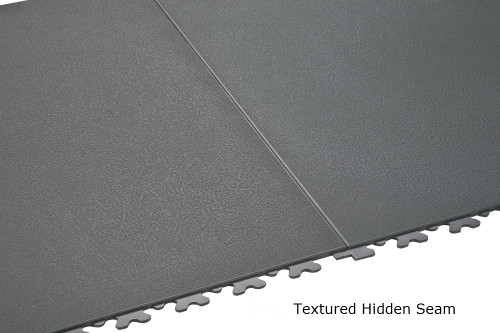
The other trade-off is seams. A tile floor shows them, and an epoxy coating gives you one continuous surface. We make both, so we’ll tell you straight which one suits your garage.
What are the different types of garage floor tiles?
There are four types of garage floor tile, and they behave very differently once a vehicle is parked on them.
- Hollow-core polypropylene: rigid snap-together tiles, usually 12 x 12 in., with a 1/16 in. wear surface over a hollow grid. Light, inexpensive, and sold vented or solid-top. Fine for display floors. Under jacks and turning tires, the thin shell and the few small connectors are what give out.
- Flexible PVC or rubber: soft, thin tiles, often 1/8 in. Comfortable to stand on, but they scratch, stain and compress under a load.
- Solid rigid PVC: one material all the way through, 3/16 to 5/16 in. thick, with nothing hollow to crush. This is what we manufacture. Our tiles are rated to 160,000 lbs rollover, hold up forklifts and fire engines, and come with an unconditional lifetime guarantee.
- Porcelain: a permanent mortared floor. It looks great, but it needs level, crack-free concrete and a professional installer.
When a buying guide tells you PVC tiles are soft, it’s talking about the flexible kind. Solid rigid PVC is a different animal, and it is the only type here that carries a lifetime guarantee.



 No Floor Prep Required
 Fast & Easy Installation. No Skills Required
 Lifetime Warranty